Start a new quote
New customer to Sun Coast? You are in the right place. Select a product below to get started.
New customer to Sun Coast? You are in the right place. Select a product below to get started.

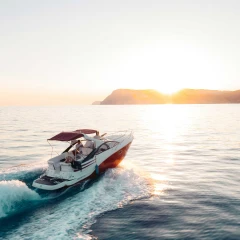











When shopping for a boat — or evaluating the one you already own — one of the most important decisions is the type of propulsion system (as well as your boat insurance). Inboard, outboard, and sterndrive (often called inboard/outboard or I/O) engines each serve different purposes and are better suited to certain boat types and uses.
Understanding how these engine types differ can help you choose a setup that matches your boating style, maintenance preferences, and long-term plans.
While there are many variations within each category, most recreational boats fall into one of three propulsion types.
Outboard engines are mounted externally on the transom of the boat. The entire engine unit pivots for steering and trims up out of the water when not in use.
Common boat types:
Why people choose outboards:
Outboards are popular for saltwater use and trailerable boats, especially where simplicity and flexibility matter.
Inboard engines are mounted inside the boat, usually near the center, with a fixed propeller shaft running through the hull.
Common boat types:
Why people choose inboards:
Because the engine is housed inside the hull, inboards are typically found on larger or more specialized boats.
Sterndrive systems combine elements of both inboard and outboard designs. The engine sits inside the boat, while the drive unit extends through the transom and can steer and trim like an outboard.
This setup is sometimes informally referred to as a “hybrid” system.
Common boat types:
Why people choose sterndrives:
Sterndrives can offer strong performance but may require more maintenance attention in certain environments.
Choosing the right engine type depends less on what’s “best” and more on how you actually use your boat.
Fishing and Coastal Cruising
Outboards are often favored for fishing boats due to easy maintenance access, shallow-water capability, and deck space.
Water Sports and Towing
Inboards are commonly used for wakeboarding and skiing because of consistent power delivery and predictable handling.
Family and Recreational Use
Sterndrives are popular on recreational boats where speed, trim control, and interior layout are priorities.
Saltwater vs. Freshwater
Saltwater environments can influence maintenance needs. Some owners prefer outboards or corrosion-resistant setups for frequent saltwater use.
Each engine type comes with different maintenance demands.
Access to service providers, storage conditions, and how often you use the boat all matter when choosing a propulsion system.
From an insurance perspective, engine type can influence factors such as vessel classification, value, maintenance expectations, and underwriting considerations. Coverage terms vary by policy and carrier, so it’s important to review how propulsion systems are addressed in your specific marine insurance policy.
There’s no one-size-fits-all answer when it comes to boat engines. The right choice depends on your boat type, intended use, and comfort with maintenance. Understanding the differences between inboard, outboard, and sterndrive systems helps ensure your boat is equipped to support the kind of time you want to spend on the water.
Disclaimer: This article is for general informational purposes only and does not constitute mechanical or insurance advice. Boat engine configurations, performance characteristics, and insurance considerations vary by vessel type, manufacturer, and policy. Always consult qualified marine professionals and your insurance provider for guidance specific to your situation.